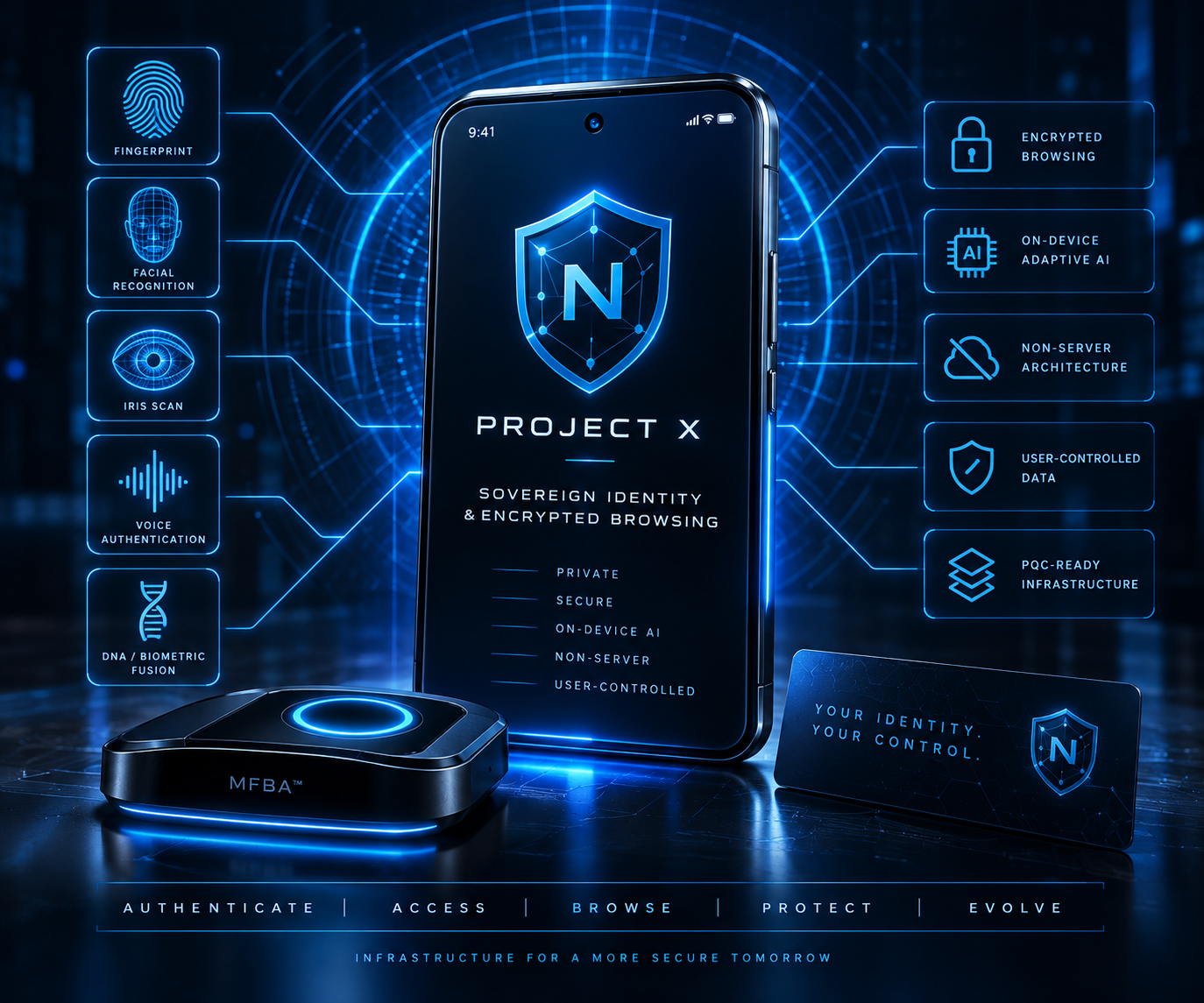
ProjectX
Sovereign Identity

Sovereign Identity
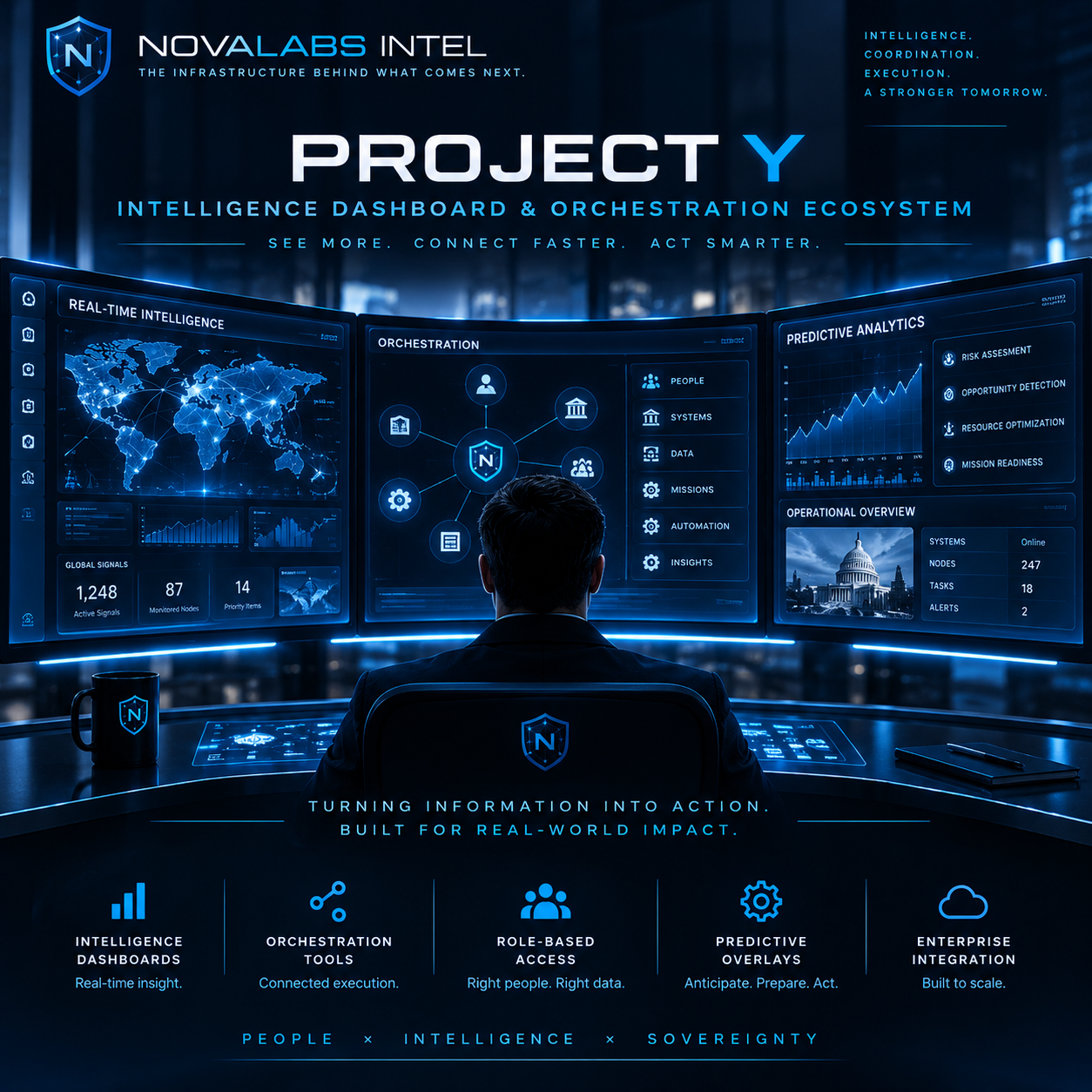
Intelligence & Orchestration
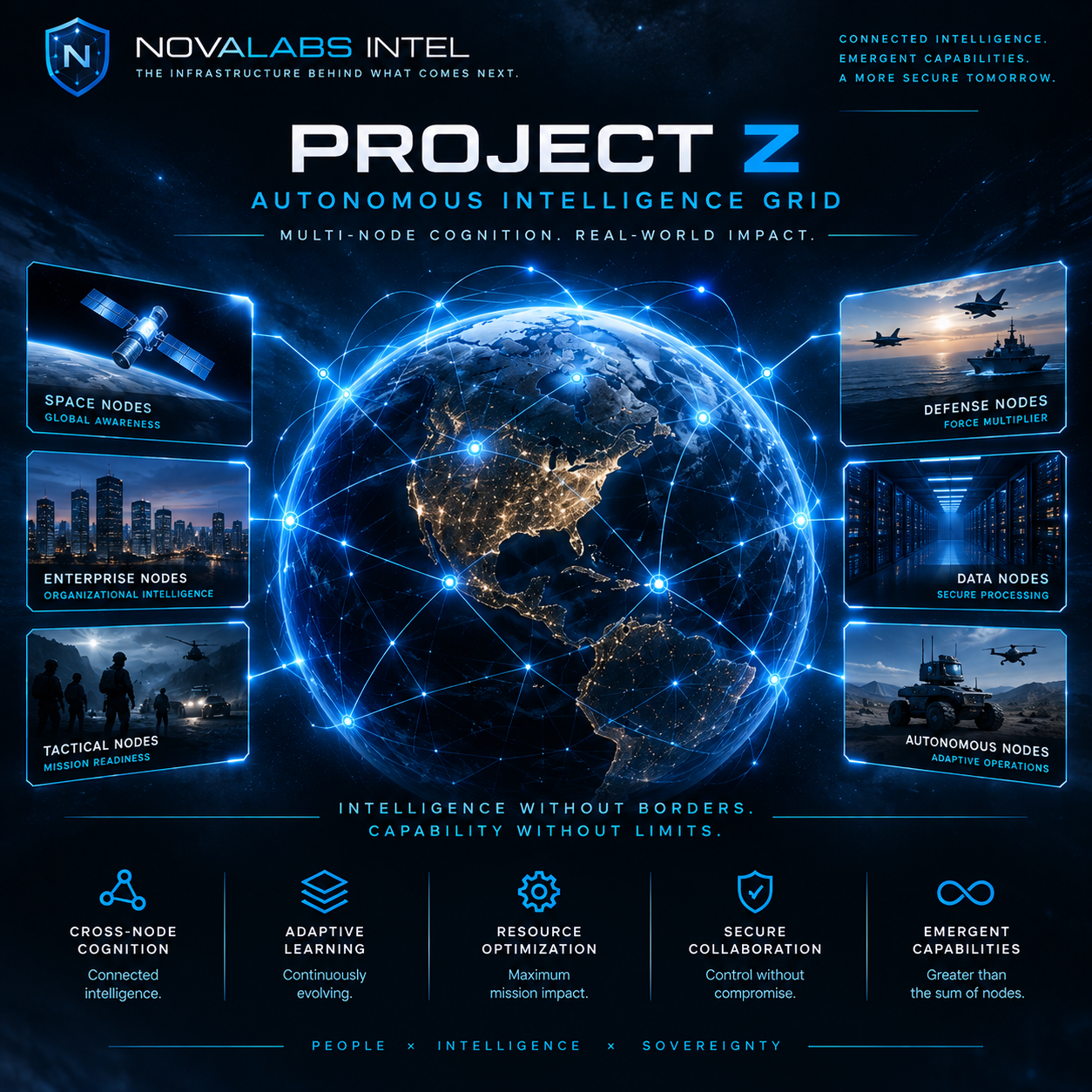
Autonomous Intelligence Grid
NovaLabs Intel is developing a next-generation infrastructure for sovereign identity, intelligent coordination, and secure human-machine interaction—designed for individuals, enterprises, and missions where trust, privacy, and autonomy matter most.
The digital identity landscape is at a critical inflection point. Legacy systems and credential-based security models face growing pressure from modern threats.
Fragmented identity can materially increase breach exposure.
Fragmented identity and device management prevent true control and continuity across systems.
Regulatory and zero-trust mandates are increasing pressure on enterprises and governments to adopt secure, scalable identity solutions.
Without foundational improvements, high-assurance operations, enterprise use cases, and sovereign user control remain vulnerable.
Today's digital identity systems are built on legacy architectures never designed for AI-scale environments or modern attack vectors. As technology advances, these foundations remain frozen in time. Continuing to rebuild on this stack is like constructing a skyscraper on an eroding foundation — each additional floor increases risk, not stability.
Legacy
Architectures facing modern threat models
Multi-factor authentication remains a meaningful control, and phishing-resistant methods raise the bar considerably. But MFA alone no longer holds the line: adversaries increasingly bypass authentication entirely through session and token theft, adversary-in-the-middle phishing, help-desk and account-recovery abuse, and consent fraud. Centralizing identity in a single provider also concentrates risk — once the session is taken, the factors have already been satisfied.
Decades of iteration have added layers of control while leaving foundational credential risks unresolved. MFBA™ proposes a different architectural approach.
| Era | Identity Model | Credential-Centric | Central Authority | Device Dependency | Serverless | Transferable Access |
|---|---|---|---|---|---|---|
| 1995–2005 | Passwords | Yes | Yes | Low | No | Yes |
| 2005–2015 | Password + Token | Yes | Yes | Medium | No | Yes |
| 2015–2023 | Multi-Factor Authentication | Yes | Yes | High | No | Reduced |
| 2023–Present | Device / Platform Identity | Yes | Yes | High | No | Reduced |
| Next | Human-Bound Identity (MFBA™) | No | No | Optional | Yes | No |
Security evolved by adding factors.
Authority evolves by changing the architecture.
Multi-Factor Biometric Authentication
Empower your identity with MFBA™ (Multi-Factor Biometric Authentication)—a customizable, human-bound security framework where control stays in your hands.
* When authority is human-bound, accountability is preserved — reducing the ambiguity associated with credential- and device-centric systems
* MFBA™ is designed for environments where knowing who acted matters as much as knowing what happened.
Authentication is anchored to the individual, not credentials or devices alone.
Users define their own biometric and behavioral verification patterns.
No central dependency—identity authority remains with the user.
Three patent-pending architectures designed to work as an integrated system for secure identity, governed orchestration, and distributed intelligence.
Core architecture for sovereign digital operations.
Identity Layer
Multi-factor biometric authentication hardware designed to establish sovereign digital identity through fingerprint, facial, and behavioral signals with hardware-bound cryptographic protection.
Designed to reduce reliance on reusable credentials and the attack surfaces associated with phishing, credential theft, replay, and unauthorized credential use.
Request Controlled AccessOrchestration Layer
A unified control architecture for managing cross-system signals, device orchestration, policy, and configurable workflows across enterprise and mission environments.
Designed to coordinate what authorized systems may do through observable, policy-directed execution.
Request Controlled AccessIntelligence Layer
A distributed artificial-intelligence architecture designed to generate insight and coordinate workflows across sovereign infrastructure while preserving local data authority.
Designed to generate intelligence across authorized sovereign nodes without requiring centralized data custody.
Request Controlled AccessArchitecture Legend
Authority originates with the individual.Policy governs execution.
Authorized systems coordinate within defined controls.Intelligence remains federated.
Insights move without centralizing identity custody.Human-bound authority governing coordinated intelligent systems without requiring centralized identity custody.
3
Patent-Pending Filings
30+
Patent Claims
Cross-Platform
Integration Design
Multi-Layer
Security Architecture
Designed for environments where identity, sovereignty, reliability, and operational assurance are mission-critical.
Sovereign identity for banking, wealth management, and fintech, designed to support regulatory requirements
Tactical operations and command-and-control architectures designed for high-assurance environments, including potential classified applications
Zero-trust architecture, privileged access management, and workforce orchestration
Identity architecture designed to support requirements in HIPAA-regulated environments, patient data sovereignty, and secure health information exchange
Personal identity management, password hardening, and sovereign web browsing
SCADA security, industrial IoT authentication, and operational technology protection
Human-bound intelligence and security across critical environments.
Founders, executives, operators
Identity becomes the control layer—not passwords, devices, or institutions.
Enterprises, regulated industries
Access adapts continuously to human behavior, not static credentials.
Global teams, sensitive operations
Trust persists across location, device, and network boundaries.
AI operators, governance teams
Every action, decision, and override is cryptographically bound to a living human.
Financial institutions, high-value transfers
Authorization is verified by the human—not the transaction alone.
Infrastructure, data centers, sensitive systems
Access decisions follow the human across digital and physical domains.
Additional applications are anticipated across defense, healthcare, and sovereign systems. Architecture and prototype stage — pilot and deployment references will be published as they are established.
NovaLabs Intel serves government missions, enterprise integration, and strategic capital. Choose the lane that matches your mandate.
Procurement · R&D · Prototyping · Teaming
Federal capabilities, contracting information, and a downloadable capability statement for contracting officers and primes.
Licensing · Integration · Pilot Programs
Architecture review, integration pathways, and structured pilot programs for regulated and zero-trust environments.
Investment · Acquisition · IP Transactions
Portfolio structure, market context, and transaction pathways for investors and acquirers of foundational IP.
By 2034, reflecting sustained enterprise demand for secure identity and access infrastructure. (Source: Precedence Research)
Rather than layering incremental controls onto credential-based systems, this technology reimagines identity infrastructure at the architectural level. It is designed to reduce reliance on reusable credentials while combining hardware-bound cryptographic protection with a seamless user experience.
Discuss a MissionWe provide comprehensive documentation tailored to each stage of partnership discussions
Initial Overview
Strategic Dialogue
Following qualification and appropriate confidentiality controls
Complete technical documentation, patent specifications, and implementation guides are available to qualified partners following mutual NDA execution and alignment verification.
High Impact, Low Disclosure
| Question | If Yes | If No |
|---|---|---|
| Does identity, access, or authorization affect your core business? | You are exposed | You are not immune |
| Would loss of identity control disrupt operations or trust? | You need leverage | You are dependent |
| Do competitors benefit if they control this layer first? | You are at risk | You are betting |
| Could licensed control of this IP create advantage? | You gain asymmetry | You remain reactive |
NovaLabs Intel engages selectively with organizations seeking strategic advantage, licensing rights, or early alignment.
Detailed disclosures are governed by NDA and suitability.
Organizations that engage early shape the terms.
Those that wait inherit them.
Connect with our team to discuss strategic partnerships and investment opportunities.
Qualified inquiries from: